If you have ever looked up from your hoop after “just one more thread” and realized your eyes feel dry, tired, or a little gritty, you are not alone. Stitching is wonderfully meditative, but tiny holes, dark fabrics, metallic thread, and late-night crafting can be a perfect recipe for eye strain. The good news is that the right light and the right magnification can make your projects feel easier on your body without making your setup fussy.
This guide covers three tool categories I reach for most: neck lights for flexible close work, daylight-style lamps for whole-workspace brightness, and magnifiers for when your eyes need a little extra backup. I will also share what actually matters when you are choosing, because “bright” is not the same as “comfortable.”
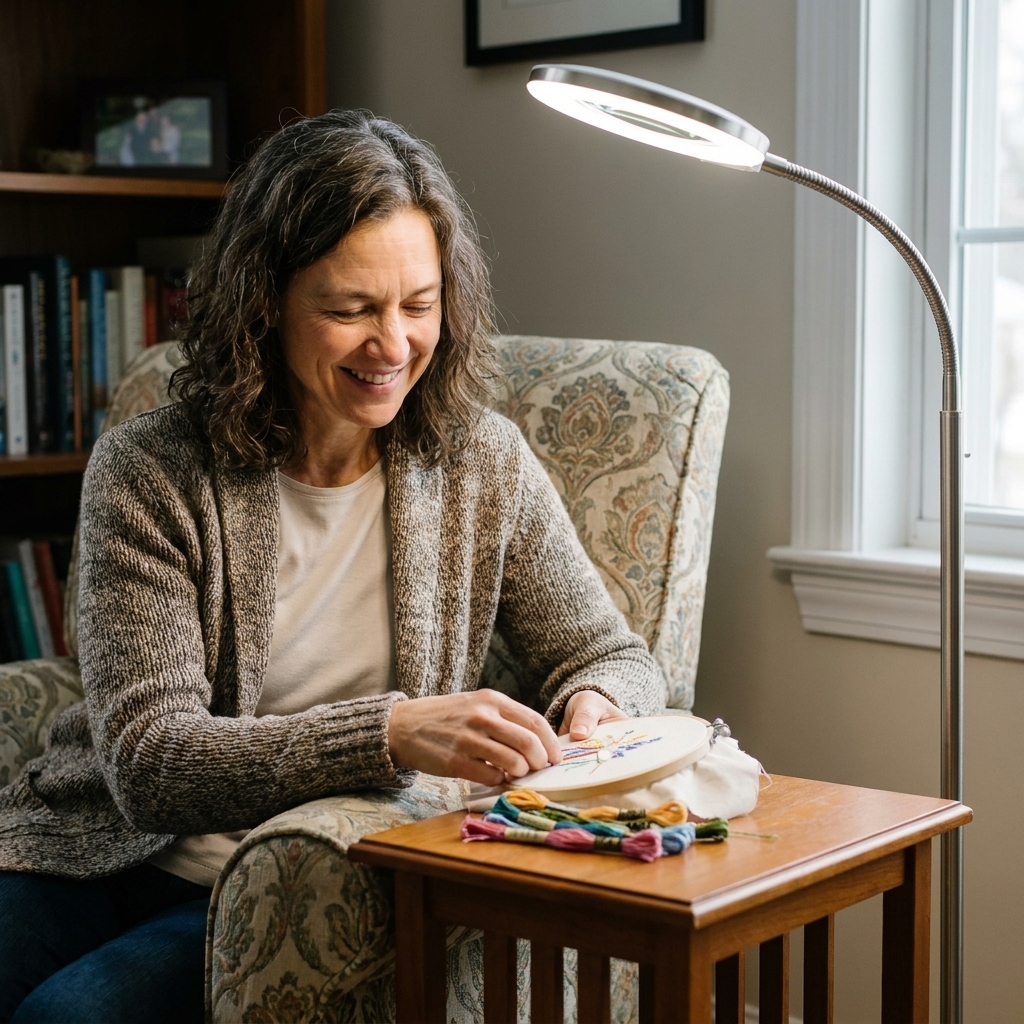
What helps eye strain
Before we get into specific products, here is the quick checklist I use when I am evaluating a lamp or magnifier for needlework.
- High, even brightness: You want enough light to see thread paths clearly without squinting, plus a wide spread so you are not staring into a harsh hotspot.
- Neutral to daylight color: As a rule of thumb, about 4000K to 6500K shows floss colors clearly and makes fabric holes easier to see. That said, if very cool light gives you headaches or glare, many stitchers feel best a little warmer, around 3500K to 4500K.
- Good color rendering (CRI): If you care about accurate color matching, look for high CRI (often 90+) when you can. Think of it as a helpful guideline, not a strict requirement.
- Stable positioning: A wobbly gooseneck or a lamp that slowly droops is a fast track to shoulder tension and constant readjusting.
- Comfortable ergonomics: The “best” lamp is the one you will actually use. For many stitchers that means quick on and off, simple controls, and no heavy clamps to wrestle.
- Know what “bright” means: “Three brightness levels” is vague. If you can find it, check lumens. For task lighting at a stitching chair or desk, roughly 800 to 1,500 lumens is a practical starting range, with dimming so you can fine-tune.
And a gentle reminder from someone who has stitched through plenty of avoidable headaches: if your eyes are straining, it is usually a lighting issue first and a skill issue never.
Best neck lights
Neck lights are my favorite “grab and stitch” solution. They travel well, they do not require a table, and they keep light aimed right at your hands. They are especially handy for stitching on dark aida, linen, or evenweave, or for when your couch spot is not close to an outlet.
The tradeoff is that neck lights can create shadows if one side is angled poorly, and the light is more directional than a room lamp. A small amount of experimenting with angle usually fixes it.
Glocusent LED Neck Reading Light (bright and easy to aim)
Why stitchers like it: Glocusent neck lights are popular for a reason. On many models, the arms hold their shape well, the light is focused enough for detailed work, and the brightness is usually strong for most everyday stitching.
- Best for: Couch stitching, travel, and rooms with mediocre overhead lighting.
- Look for: Models with multiple color temperatures (warm, neutral, cool) and several brightness levels so you can tune it to your fabric.
- My tip: Aim one side slightly higher and one side slightly lower to reduce glare on shiny threads like metallics or satin floss.
Vekkia Rechargeable Neck Light (softer for sensitive eyes)
Why it works: Some neck lights feel like two little flashlights pointed at your work. If your eyes prefer a softer, more diffuse glow, Vekkia-style designs can feel gentler while still giving useful task lighting.
- Best for: Stitchers who get headaches from harsh direct light.
- Watch for: Maximum brightness. If you stitch on black fabric or do very high-count work, you may want the brightest option available.
OttLite Rechargeable Neck Light (good color rendering)
Why it shines: OttLite built its reputation around daylight-style lighting. Depending on the model, you may also get strong color rendering, which is helpful if you are constantly second-guessing whether that floss is “peach” or “pale pink.”
- Best for: Color-critical embroidery, surface stitching, and anyone who swaps threads frequently and wants them to look consistent between day and night.
- My tip: Pair a neck light with a room lamp on low. Your eyes relax when the whole room is not dramatically darker than your stitching zone.
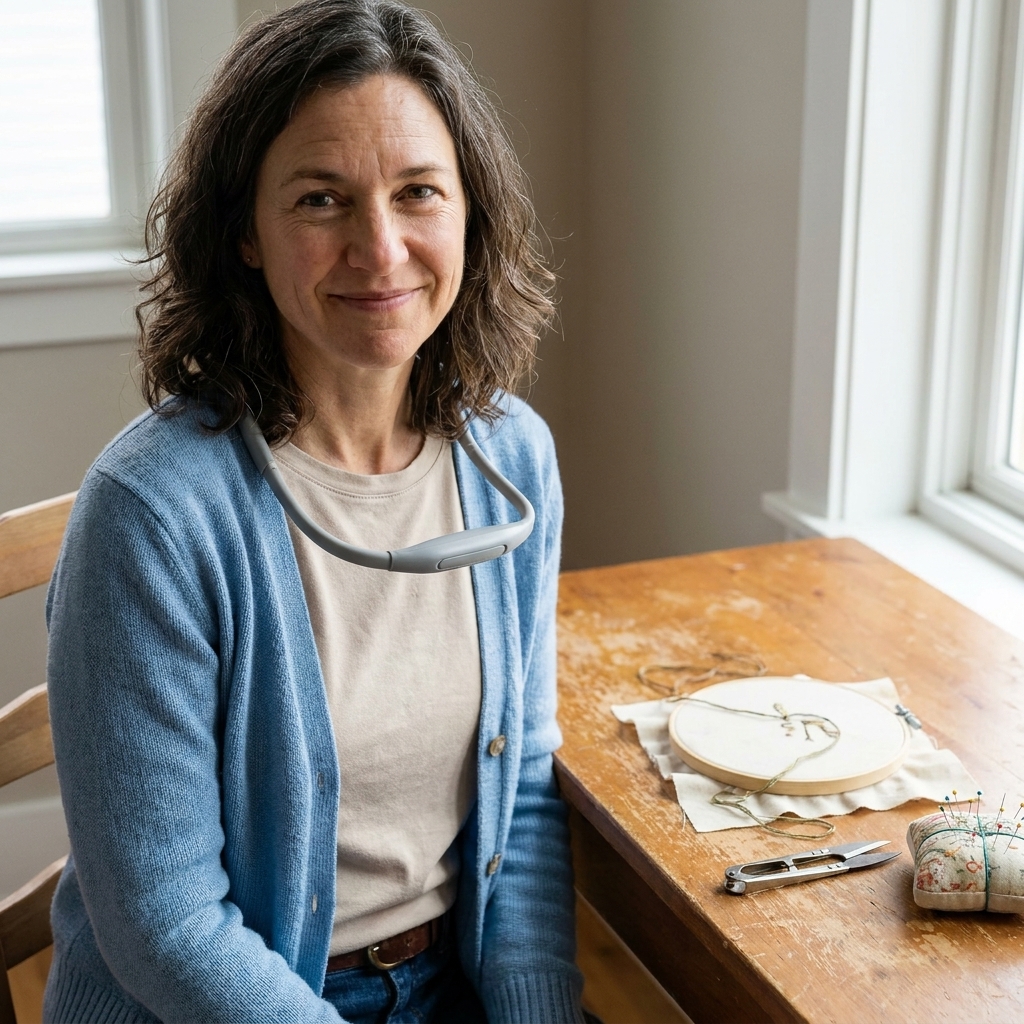
Neck light buying tips
- Weight matters: If it feels heavy around your neck in the first five minutes, it will feel heavier after an hour.
- Separate controls are a plus: Independent left and right brightness can help reduce shadows.
- Rechargeable beats disposable: AAAs run out right when you are counting on them. Rechargeable is less hassle.
- Check the beam angle: Wider is usually more comfortable, narrower can be better for very detailed work.
Best daylight-style lamps
If you mainly stitch at a dedicated spot, a good daylight-style lamp is the biggest quality-of-life upgrade. The goal is even, shadow-free brightness that covers your hoop, your chart or pattern, and your hands without you needing to lean forward like a stressed-out shrimp.
OttLite floor lamps (even light for crafts)
Why they are a staple: OttLite floor lamps often deliver consistent daylight-style light with good coverage. Many models include adjustable height and a shade or diffuser that spreads light comfortably.
- Best for: Cross stitch, embroidery, quilting, and any craft corner where you want plug-in reliability.
- Look for: A wide shade and a stable base. If you stitch in an armchair, make sure the lamp head can reach over your lap without tipping.
Daylight Company lamps (crisp task lighting)
Why stitchers choose them: Daylight Company lamps are commonly recommended in needlework shops and classes, and many stitchers describe the light as clean and clear without feeling harsh. If you do detailed work, that “clear” feeling matters.
- Best for: Detailed surface embroidery, high-count fabric, beading, and finishing work like lacing and mounting.
- Look for: Models with dimming so you can match the light to the time of day and your eyes.
Brightech Litespan-style LED floor lamps (budget-friendly)
Why it is worth considering: If you want a bright, adjustable lamp without spending specialty-craft money, Brightech-style floor task lamps can be a solid choice. Many have flexible heads and strong output for the price.
- Best for: Beginners building a setup, or anyone who needs a second lamp for a different room.
- Watch for: Color temperature and CRI. Some budget LEDs can make floss look a little “off.”
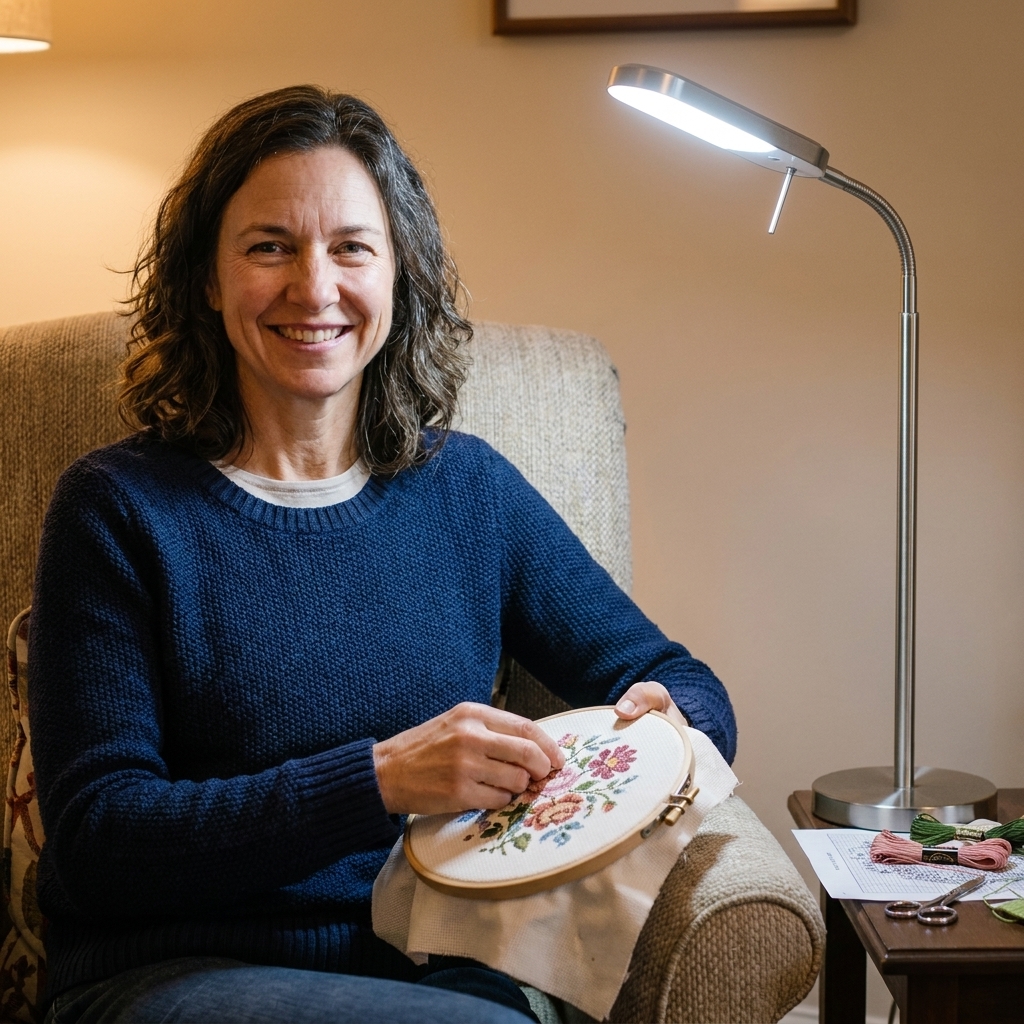
Where to place your lamp
- Place the lamp slightly in front of you, off to your non-dominant side. This reduces shadows from your stitching hand.
- Aim the light across the fabric, not straight down. Raking light helps you see holes and texture without as much glare.
- Light your chart too. If your fabric is bright but your pattern is dim, your eyes keep refocusing and that can feel exhausting.
- Hide bare LED points from your eyes. A diffuser shade, a slightly higher lamp position, or simply angling the head away from your line of sight can make “bright” feel a lot more comfortable.
Best magnifiers
Magnification is not “cheating.” It is a tool, like a needle threader or good scissors. If you stitch on 32 count linen, do 1 over 1, use dark fabric, or simply want your eyes to feel relaxed at the end of a session, a magnifier can be a game changer.
Daylight Company magnifier lamps (all-in-one helper)
Why it is popular: A magnifier lamp combines bright light and a large lens so you are not juggling tools. For finishing work, backstitch, and detailed areas, it is wonderfully steady.
- Best for: High detail, specialty stitches, beading, and stitchers who like to work at a table or stand.
- Choose your lens wisely: Many stitchers do best with 1.75x to 2.25x. Higher magnification can shrink your field of view and make it harder to track where you are.
OttLite magnifier lamps (comfortable light plus magnification)
Why it works: OttLite magnifier lamps often pair pleasant, even lighting with a lens size that feels practical for crafts, not just quick reading.
- Best for: Stitchers who want dependable lighting plus magnification without piecing together separate tools.
- My tip: If you wear glasses, test whether you prefer using the magnifier with or without them. Many people keep their glasses on and use a lower-power lens.
Clip-on and stand magnifiers (small and portable)
Why they are handy: Clip-on magnifiers can be great for travel or occasional use. They are also a low-commitment way to discover what magnification strength you like before investing in a lamp.
- Best for: Quick detail checks, traveling with a small project, and stitchers who do not have space for a floor lamp.
- Watch for: Wobble. A shaky clip can be more irritating than helpful.
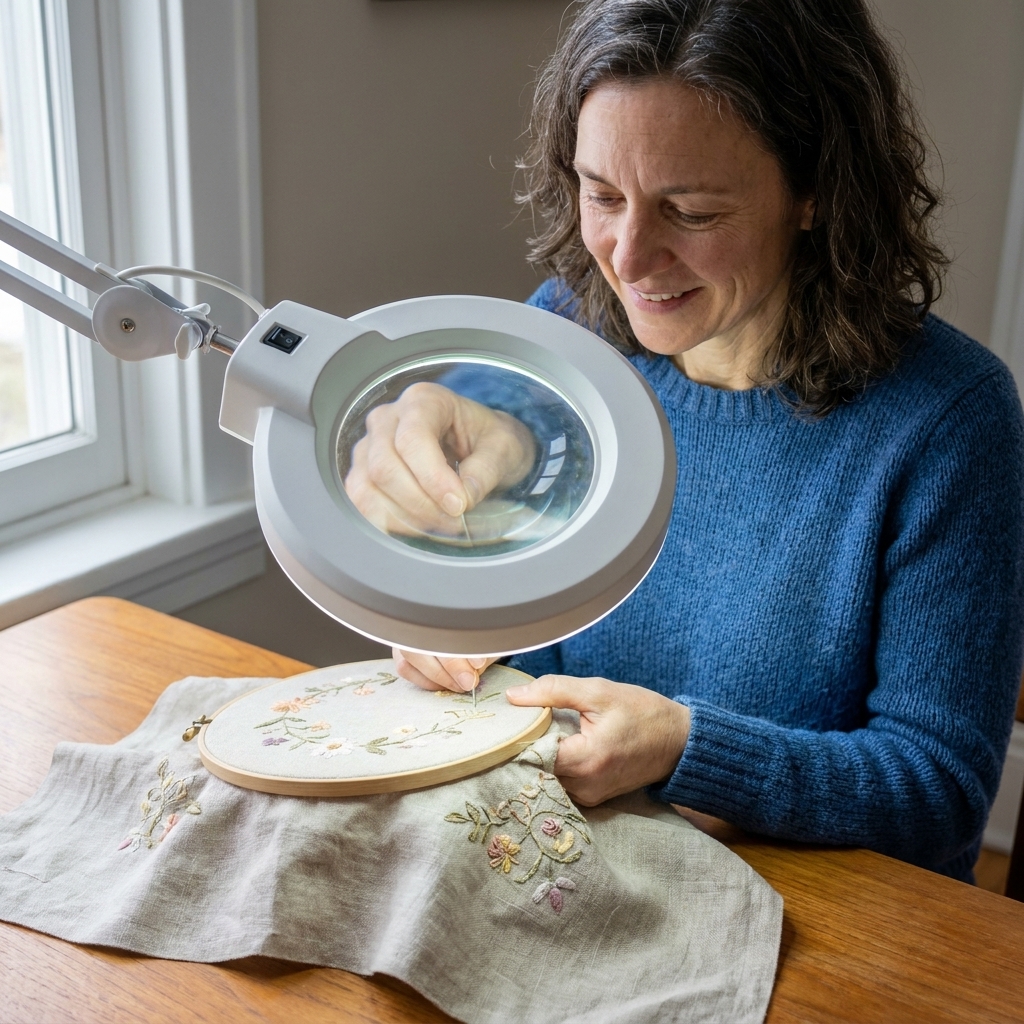
Lens material matters
- Glass lenses: Usually clearer and more scratch-resistant, but heavier.
- Acrylic lenses: Lighter and often more affordable, but can scratch more easily over time.
How much magnification
These ranges are a helpful starting point. Your comfort depends on your eyesight, your glasses prescription, and how close you naturally hold your work.
- 1.5x to 1.75x: Great for general clarity without feeling like you are “inside” the fabric.
- 2.0x to 2.25x: A sweet spot for many stitchers doing higher counts or detailed backstitch.
- 3.0x and up: Best for tiny specialty tasks, not usually ideal for full sessions because the viewing area is smaller.
Quick picks
If you want the simplest match for how you stitch, start here.
- I stitch on the couch and move around: A rechargeable neck light plus a soft room lamp.
- I have a dedicated craft chair: A dimmable daylight-style floor lamp, ideally with published lumen output.
- I do high-count linen or 1 over 1: A magnifier lamp with a daylight-style LED, ideally 1.75x to 2.25x.
- I stitch dark fabrics a lot: Bright, cool-neutral lighting and a second light source to reduce shadows.
- I get headaches from harsh light: Choose diffused LEDs, use dimming, and consider a slightly warmer neutral setting.
Setup habits
Even the fanciest lamp cannot fix a setup that forces your eyes to refocus constantly. These small changes help more than you would think.
- Raise your work: Use a hoop stand or prop pillows so your project is closer to eye level. Less neck bend often means less eye fatigue.
- Try the 20-20-20 reset: About every 20 minutes, look at something around 20 feet away for 20 seconds. It is a tiny break that makes long sessions feel easier.
- Keep your chart well-lit: If you are working from paper, clip it into the same lighting zone as your hoop.
- Reduce glare: If your light makes your fabric shiny, angle the lamp slightly, add diffusion if you can, and drop brightness one step.
- Help dry eyes: Blink more than you think you need to, and consider a more humid room if you are always feeling scratchy. If dryness or headaches are persistent, an eye exam is worth it.
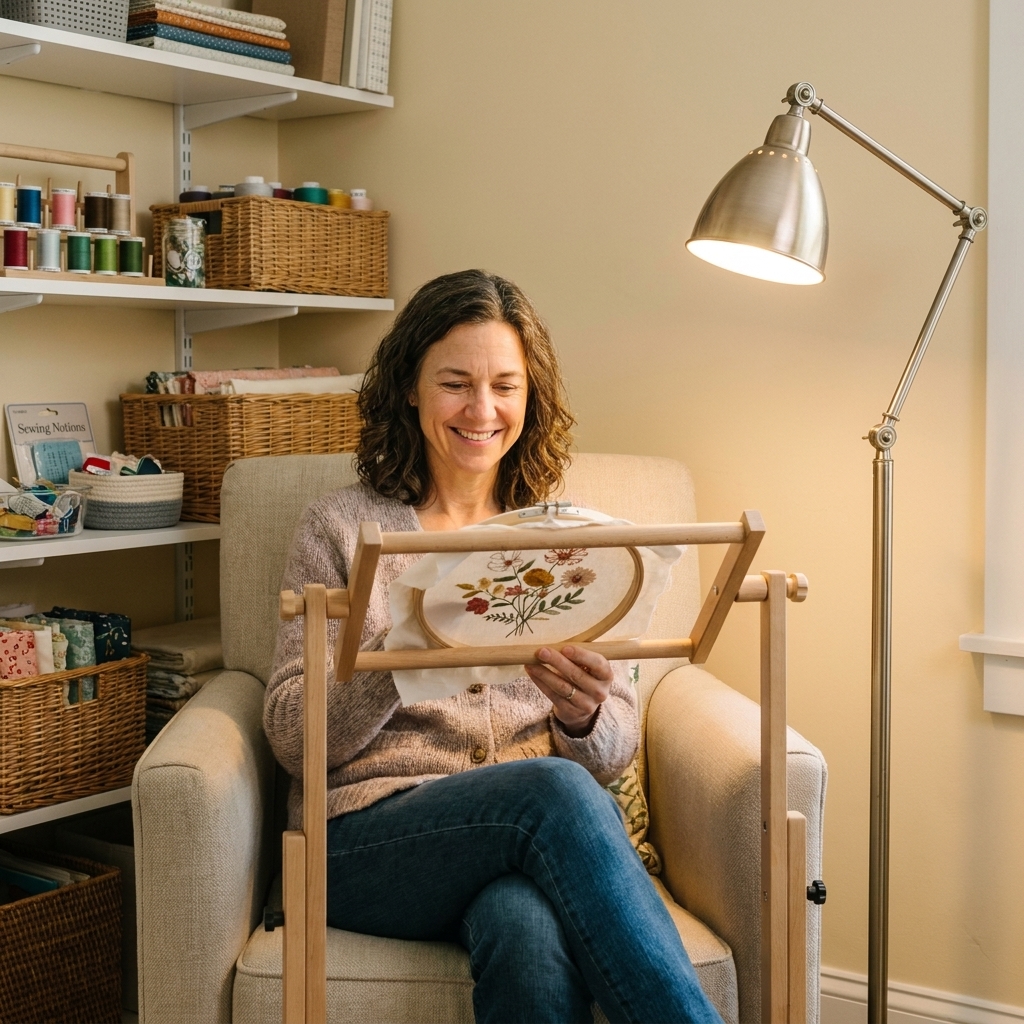
My cozy rule: If I catch myself squinting, I do not push through. I adjust the light first, then grab magnification if I still feel tense. Crafting is supposed to be relaxing, not a test of endurance.
FAQ
Is daylight lighting better for cross stitch?
Often, yes. Daylight or neutral-white LEDs tend to show fabric holes and thread contrast more clearly than warm yellow bulbs. They also help your floss colors look closer to how they appear in natural daylight, which is useful if you match colors across multiple sessions. If cool light feels glaring, shift toward a neutral setting and rely on higher brightness and good diffusion instead.
Do magnifier lamps distort the fabric?
A good lens should not distort much in the center, but you may notice slight distortion near the edges. If it bothers you, choose a lamp with a larger lens or a slightly lower magnification so you are not working at the edge of the viewing area.
Neck light or floor lamp?
For pure comfort during long sessions, a floor lamp usually wins because it brightens a wider area and keeps weight off your neck. For flexibility and travel, a neck light is hard to beat. Many stitchers use both: a floor lamp for home, a neck light for everywhere else.
What if my light causes glare on metallic thread?
Angle the lamp so the beam skims across the work instead of pointing straight at it, then lower brightness one step. You can also add a second, softer light source in the room to reduce the harsh contrast that makes glare feel intense.
When should I get my eyes checked?
If you are getting frequent headaches, sudden changes in vision, or irritation that does not improve with better lighting and breaks, it is a good time to schedule an eye exam. Sometimes a magnifier does not “fix” the problem so much as it reveals that your prescription has changed.
My bottom line
If I had to pick just one upgrade for most stitchers, it would be a good dimmable daylight-style floor lamp. If you stitch in lots of different places, start with a comfortable rechargeable neck light. And if your eyes are doing that tired, unfocused thing even in bright light, add magnification and let your body relax into the craft again.
Whatever you choose, the goal is the same: clear stitches, calmer eyes, and more time enjoying the rhythm of needle and thread.